NVIDIA expands real-time AI production tools at IBC 2026
NVIDIA expanded its AI for Media stack with synthetic-video detection, AI-assisted replay, enhancement, sports-model playbooks and live localization components for broadcast and streaming workflows.
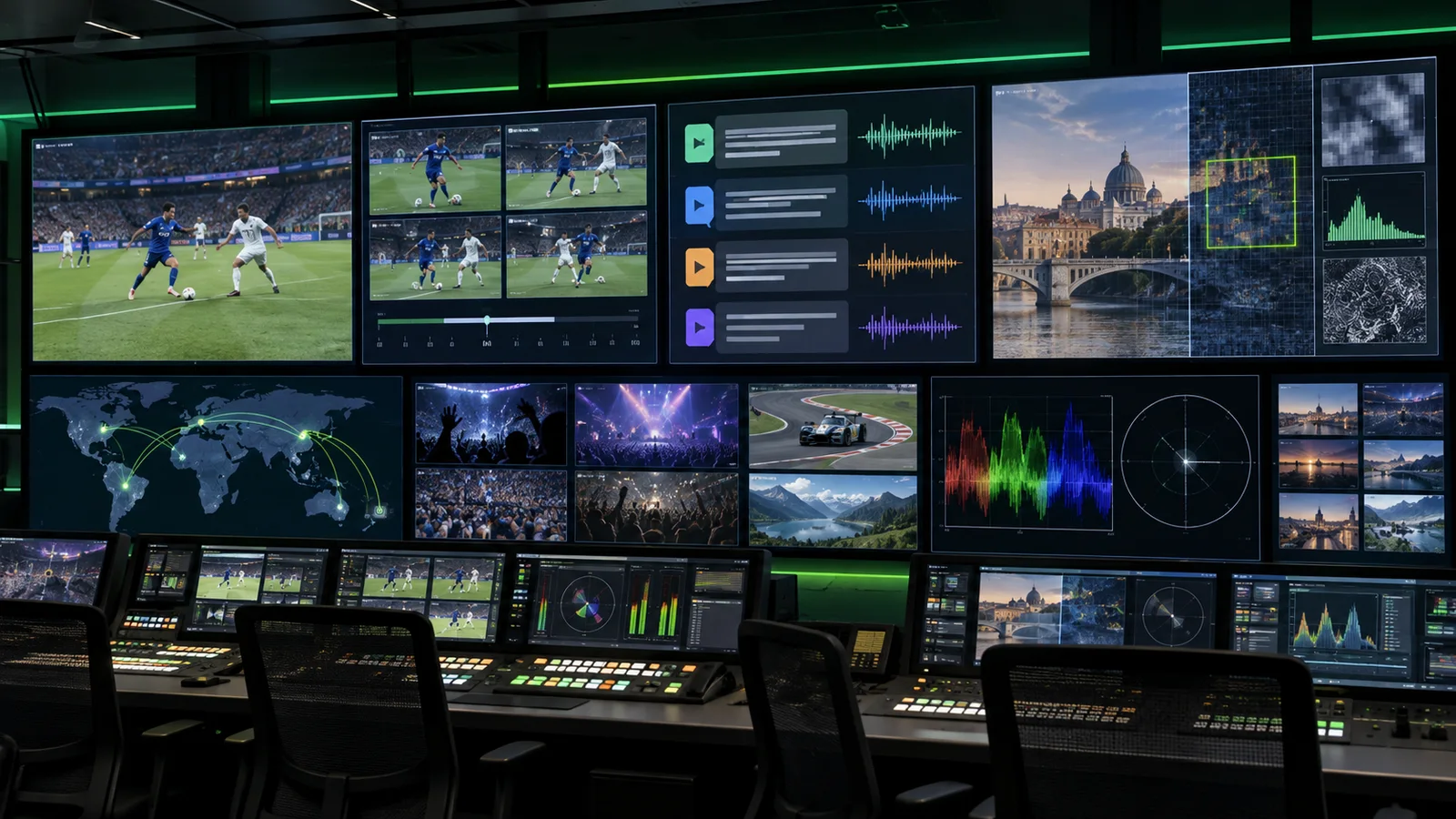
NVIDIA announced an expansion of its AI for Media software on September 9, covering tools for synthetic-video checks, sports replay, image enhancement and multilingual production. The IBC 2026 announcement packages the capabilities as GPU-accelerated SDKs, NIM microservices, playbooks and reference workflows that media-technology partners can integrate into broadcast and streaming systems.
The release brings NVIDIA’s Synthetic Video Detector, or SVD, into partner workflows, where it can send an authenticity signal to human reviewers. The downloadable NIM microservice estimates whether a video was AI-generated. NVIDIA describes the result as an additional analysis signal, not a substitute for editorial or forensic review. NVIDIA claims 99.3% accuracy on text-to-video content and 97.7% on image-to-video content, but its published materials do not disclose the evaluation dataset, sample size or methodology.
Dalet is integrating SVD into Dalet Flex so results can be written into asset metadata and trigger review, approval and human-validation steps. Dalet says the integration is currently limited to proof-of-concept deployments. TwelveLabs combines SVD’s frame-level authenticity signals and confidence scores with contextual, rule-based compliance findings in its managed Compliance service. Wowza offers SVD as an opt-in detector in its Video Intelligence Framework for live video, with local, hosted or self-hosted endpoints and support for controlled or air-gapped environments subject to setup and model-access requirements.
For sports production, NVIDIA says its Video Frame Generation software inserts intermediate frames to double or quadruple a source’s frame rate. Ross Video is integrating the technology into Rio Replay for AI-assisted slow motion, according to NVIDIA. Support has been announced for 6x slow motion, while 8x interpolation remains in development. NVIDIA also updated Video Super Resolution with selectable streaming modes, adjustment controls and 10-bit support. TrueHDR can convert standard-dynamic-range footage to HDR in real time at up to about 2,000 nits, the company says. The three tools can run in one effects pipeline.
The new Sports Intelligence Playbooks provide recipes for preparing data, fine-tuning sport-specific multimodal models with supervised fine-tuning or LoRA, testing them and optimizing them for deployment using an organization’s footage and annotations. NVIDIA reports that early sports-domain tests raised multiple-choice accuracy from about 53% to 94% and open-ended evaluation scores from about 5.7% to 66%. The company did not publish enough detail about training data, held-out samples or independent evaluation to validate those gains.
NVIDIA says Machina Sports is combining the playbooks with its sports-data and agent infrastructure. It also says Wowza is fine-tuning Cosmos 3 and Nemotron vision-language models to recognize sport-specific moments in live streams. Those two partner integrations are attributed only to NVIDIA in the cited evidence.
NVIDIA’s localization work centers on the LipSync and Active Speaker Detection NIM microservices. LipSync changes mouth motion to match target audio, while Active Speaker Detection identifies and tracks speakers. NVIDIA says the updates improve handling of partially occluded faces, add voice-activity detection, remove a multi-track diarization requirement, broaden GPU support and add a gRPC interface. The company also says NDI is using AI for Media, including LipSync, for real-time translation, lip-synced dubbing and regional-language versions of a shared media stream. That integration is attributed only to NVIDIA in the cited evidence.
NVIDIA is also adding content-localization components to Holoscan for Media as a composable reference workflow for captions, translated audio, dubbing, synchronized video and localized graphics across live, file-based, streaming and post-production uses. Its IBC event materials describe a demonstration with AI-Media, CAMB.AI, Chyron and Panjaya. The cited evidence does not independently confirm each partner’s role or the components’ commercial availability.
For software-defined production, NVIDIA is integrating the open-source Media eXchange Layer with Holoscan for Media, allowing containerized media functions to exchange live video, audio and data. The European Broadcasting Union’s MXL materials describe the layer as an interoperability mechanism and list an NVIDIA-supported IBC 2026 demonstration.
More news
AWS releases six open-source Hugging Face deployment skills for SageMaker
Google Research releases MilleMiglia logistics benchmark generator

AWS launches AgentCore Runtime V2 with elastic memory and snapshot starts