Meta's non-invasive Brain2Qwerty v2 decodes typed sentences from brain signals at 61% accuracy
Meta published Brain2Qwerty v2 in Nature Neuroscience on June 29, 2026, a non-invasive system that decodes typed sentences from MEG brain signals at 61% average word accuracy.
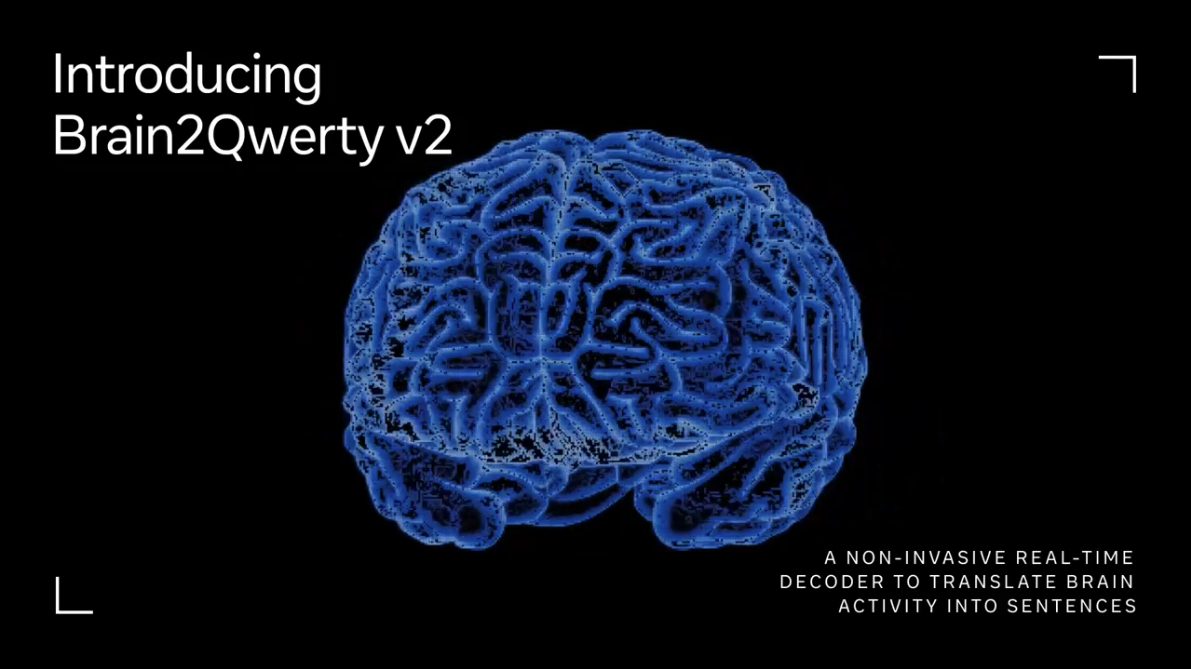
Meta AI published Brain2Qwerty v2 on June 29, 2026 alongside a peer-reviewed paper in Nature Neuroscience, reporting that the non-invasive system decodes intended typed sentences from magnetoencephalography brain recordings at 61% average word accuracy, with no surgical implant. The Brain2Qwerty research targets restoring communication for people with severe speech and motor impairments.
The headline number matters because of where the field started. Prior non-invasive methods decoded text at roughly 8% word accuracy; Brain2Qwerty v2’s 61% average is a large jump for an approach that avoids the surgery brain-computer interfaces from companies like Neuralink require. The best single participant reached 78% word accuracy, with more than half of that participant’s sentences decoded at one word error or fewer, Meta said.
The system, which reads brain signals from a person typing while wearing a magnetoencephalography device, chains three components: a convolutional encoder that reads raw signals, a transformer that models long-range structure, and a character-level language model that constrains the output to plausible text. Training drew on roughly 22,000 sentences from nine volunteers, each recording about 10 hours.
The caveats are substantial. Magnetoencephalography requires a shielded room and a multimillion-dollar scanner, so this is laboratory science, not a wearable. The accuracy is participant-specific, the volunteer pool is tiny at nine people, and 61% leaves frequent errors in continuous text.
Meta is releasing full training code for both versions, and the Basque Center on Cognition, Brain, and Language is releasing the v1 dataset. Version 1 first appeared in February 2025; the open code and data give outside groups a path to test the 61% figure rather than take it on the company’s word.

Founder and Chief Editor of Data Phoenix — a San Francisco Bay Area media and education platform focused on AI and Data.
More news
AWS releases six open-source Hugging Face deployment skills for SageMaker

Google Research releases MilleMiglia logistics benchmark generator

AWS launches AgentCore Runtime V2 with elastic memory and snapshot starts