Google Research releases MilleMiglia logistics benchmark generator
Google Research released MilleMiglia, an open-source C++ generator for reproducible middle-mile logistics test instances. Its specialized solver and API are still in development.
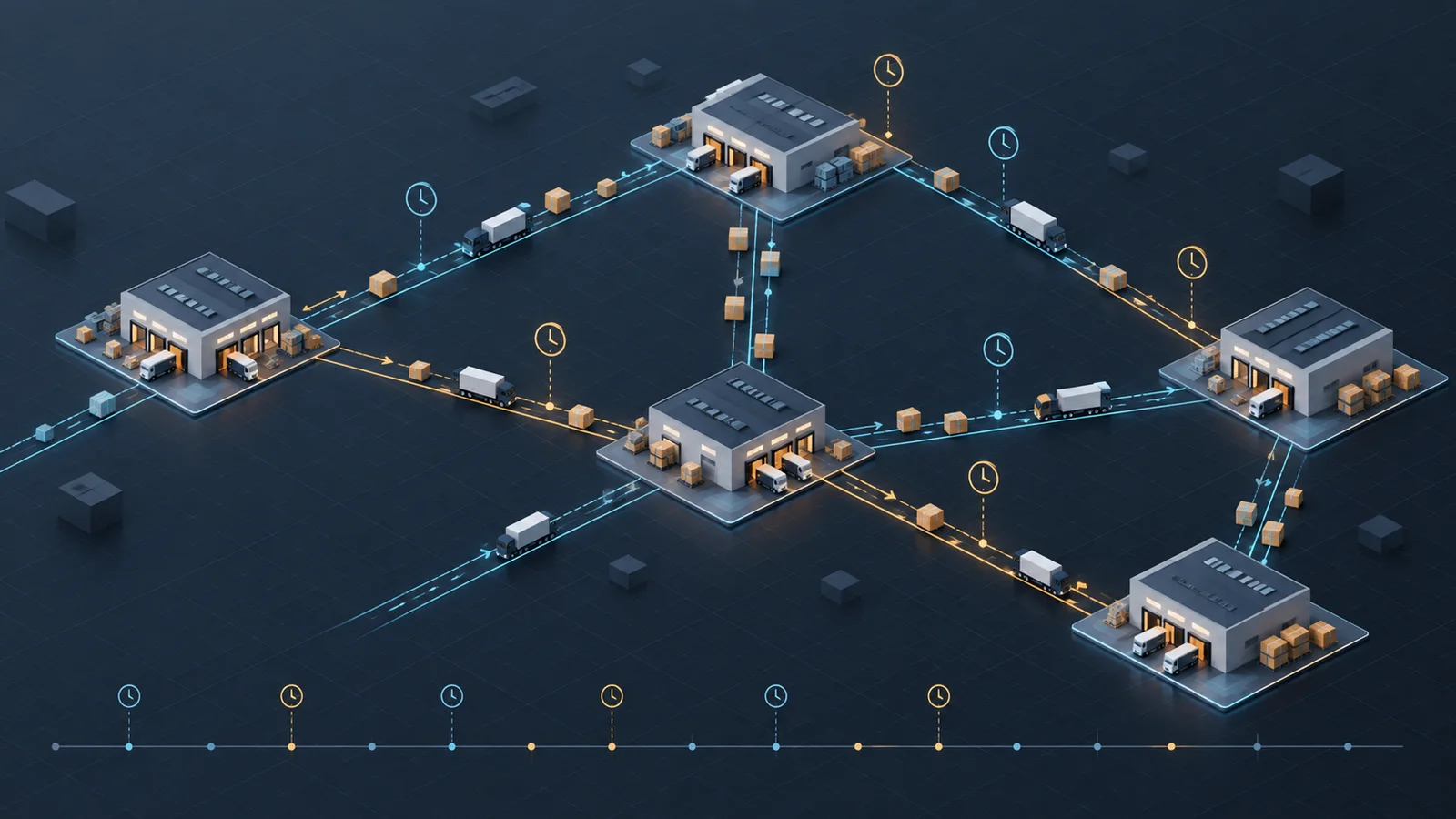
Google Research released MilleMiglia, an open-source C++ generator for synthetic middle-mile logistics benchmark instances. It gives optimization and machine-learning researchers a repeatable source of test data without requiring access to a carrier’s commercially sensitive network and demand records.
The release includes the instance generator, source code and documentation. It does not include the specialized middle-mile solver or API that Google says it is developing with academic partners. The announcement gives no availability date, access terms or performance results for those projects.
Middle-mile logistics covers shipments moving between facilities, rather than the final trip to a customer. Google describes the optimization problem as a multi-commodity flow model on a space-time graph. Each node represents a distribution center during a time interval; each arc represents either vehicle movement or storage at a center. Generated instances can account for fixed vehicle schedules, distribution-center throughput limits and dependencies that synchronize arriving and departing vehicles.
Google says MilleMiglia creates synthetic networks using statistical distributions for hub placement, origin-destination demand, shipment volume and weight, and structured vehicle rotations. The company calls the approach privacy-preserving, saying the synthetic networks are designed not to reveal private information, although the distributions draw on public industry information and privately disclosed data. The released materials include neither an independent privacy evaluation nor external validation showing that the output reproduces real carrier networks.
The command-line program accepts a fixed integer random seed, so users can repeat the same configured random-generation process. Its effective generation options include hub and shipment counts, graph density, time horizon, vehicle capacity and path length. A Google Research record for the underlying 2024 work describes the C++ library as a tool for comparing optimization methods, training machine-learning models and studying network configurations. MilleMiglia applies synthetic data to logistics optimization, a different use case from Google Research’s ToolGrad system for generating tool-use training examples.
MilleMiglia serializes each instance in a Protocol Buffers text-format file. Google says the format is compact and can be consumed by solvers written in different programming languages. The company says the generator can produce everything from small toy examples to large continent-wide, industrial-style instances and datasets for machine-learning training. The public repository is licensed under Apache License 2.0. The release includes no comparative results for optimization or machine-learning methods run on its instances.
More news

AWS releases six open-source Hugging Face deployment skills for SageMaker

AWS launches AgentCore Runtime V2 with elastic memory and snapshot starts

AWS brings Kimi K3 to Bedrock with a 1M-token context window