NVIDIA adds CUDA-Q Logical for fault-tolerant quantum development
NVIDIA has released CUDA-Q Logical in preview, bringing algorithms, error correction and hardware choices into one open-source workflow for fault-tolerant quantum development.
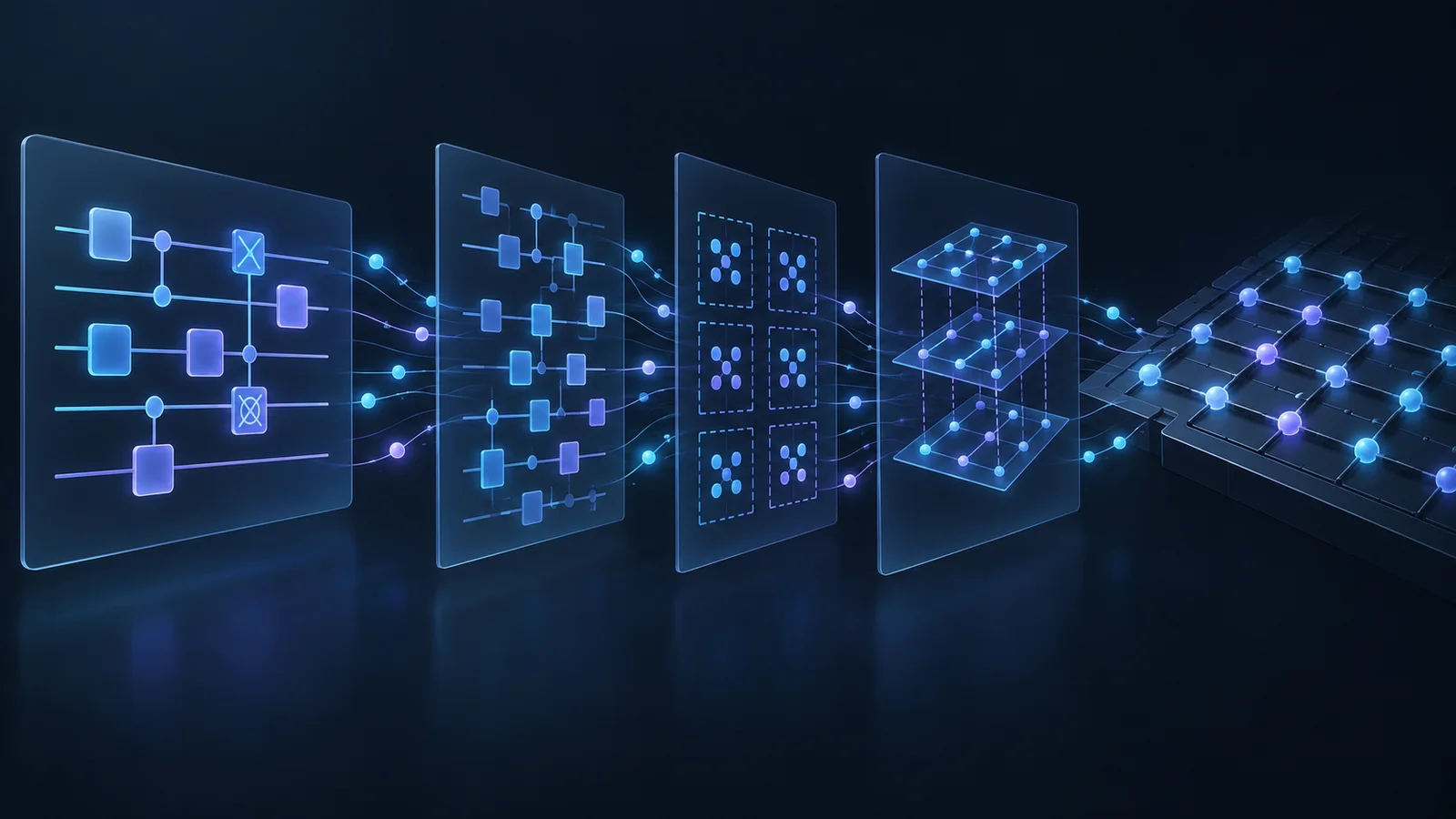
NVIDIA has released CUDA-Q Logical, an open-source orchestration layer for designing and evaluating fault-tolerant quantum applications. The software is available through NVIDIA’s CUDA-Q repository. Its documentation describes the current package as a preview whose APIs, behavior and documentation may change substantially.
Within one workflow, researchers can keep a quantum workload fixed while varying the error-correction code, logical architecture, physical hardware, decoding, control and classical-computing configuration. That setup lets researchers compare resource estimates across competing system designs. The quantum tooling is separate from NVIDIA’s recent release of Nemotron 3.5 Lightning and NeMo Switchyard, which targets the cost of multi-agent AI systems.
CUDA-Q Logical accepts either an existing CUDA-Q kernel or a portable logical program written directly by a developer. Users can configure error-correction codes, gadgets, qubit placement and magic-state distillation protocols, then generate resource estimates or realized programs for simulation and further analysis with tools including Stim. According to the official documentation, the package is pre-installed with cudaq and is also available through pip.
An NVIDIA-authored research paper describes a staged compiler that lowers a hardware-independent logical program through a logical virtual machine, error-correction microcode, physical gate schedules and real-time control plans. In practice, the compiler progressively translates an algorithm into operations a chosen fault-tolerant machine could execute, retaining information about how each stage was produced.
NVIDIA said Fermilab used the platform to cut an architecture-development workflow from about five months to three weeks, a result the company characterized as a sevenfold speedup. NVIDIA also said Iceberg Quantum modeled 1,000 logical qubits for Diraq with 150,000 physical qubits, about one-tenth of a previous Diraq estimate. The announcement did not provide enough methodology or independent evidence to validate either comparison.
NVIDIA named drug discovery, financial modeling and materials development as prospective application areas. The supplied evidence does not show that CUDA-Q Logical has produced practical results in those fields. The official documentation does not state a stable-API or general-availability commitment for the preview.
More news

AWS releases six open-source Hugging Face deployment skills for SageMaker

Google Research releases MilleMiglia logistics benchmark generator

AWS launches AgentCore Runtime V2 with elastic memory and snapshot starts