GPT-5.6 Sol helped mathematicians disprove Maxwell's 150-year-old conjecture
Three mathematicians posted an arXiv paper on July 29, 2026 disproving Maxwell's 1873 conjecture, crediting OpenAI's GPT-5.6 Sol with suggesting the key construction.
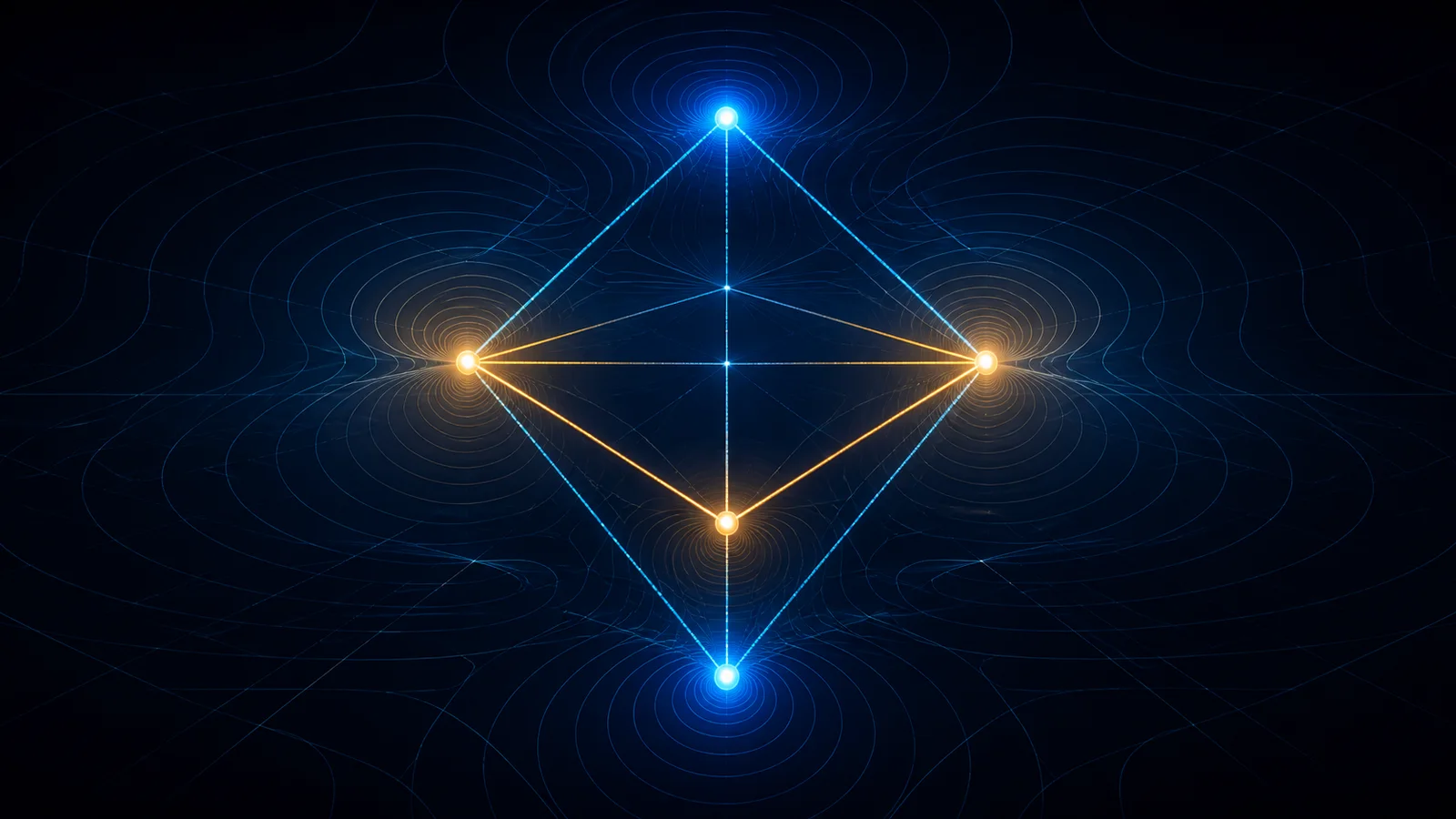
Three mathematicians posted a paper titled “The Maxwell Conjecture is False” to arXiv on July 29, 2026, and credited OpenAI’s GPT-5.6 Sol language model with suggesting the geometric construction at its core.
Philip Arathoon of Babson College, Gavin Ball of the University of Missouri and Matthew D. Kvalheim of the University of Maryland, Baltimore County built a five-point-charge configuration whose electrostatic potential has at least 24 non-degenerate critical points. That exceeds the maximum of 16, or (n-1) squared for five charges, that James Clerk Maxwell conjectured in 1873.
By the authors’ account, GPT-5.6 Sol proposed the key idea: a triangular bipyramid with axially placed shrinking charges. The human authors then independently verified and wrote up every step.
The claim rests on limited corroboration. The finding is a preprint that has not been peer-reviewed, and there is no first-party OpenAI writeup detailing what the model contributed; the account of GPT-5.6 Sol’s role comes from the authors themselves. The mathematics stands or falls on the paper’s own proof, which any referee can check independently of how the idea was found.
Still, a machine suggesting a viable construction that humans then verified is a concrete example of the research assist AI developers have promised in mathematics, narrower than “AI proved a theorem” but more than autocomplete.
More news

AWS releases six open-source Hugging Face deployment skills for SageMaker

Google Research releases MilleMiglia logistics benchmark generator

AWS launches AgentCore Runtime V2 with elastic memory and snapshot starts