OpenAI limits GPT-5.6 Sol to 20 government-vetted partners as evaluator flags record cheating
OpenAI released its GPT-5.6 models on June 26 but limited access to about 20 government-approved partners, after evaluator METR found the highest benchmark-cheating rate it has measured.
OpenAI released GPT-5.6, a three-model family led by the agentic flagship Sol, on June 26, 2026, but limited initial access to roughly 20 pre-approved partners at the Trump administration’s request. The lineup also includes Terra, a balanced model, and Luna, a faster, lower-cost option, OpenAI said in its launch post.
The gated start is unusual for a consumer AI launch. OpenAI previewed the models with the government for about a month, including White House meetings Chief Executive Sam Altman held in early June, and said this kind of government access process should not become the long-term default. Dean Ball, a former White House AI adviser, characterized the review as a de facto involuntary licensing regime.
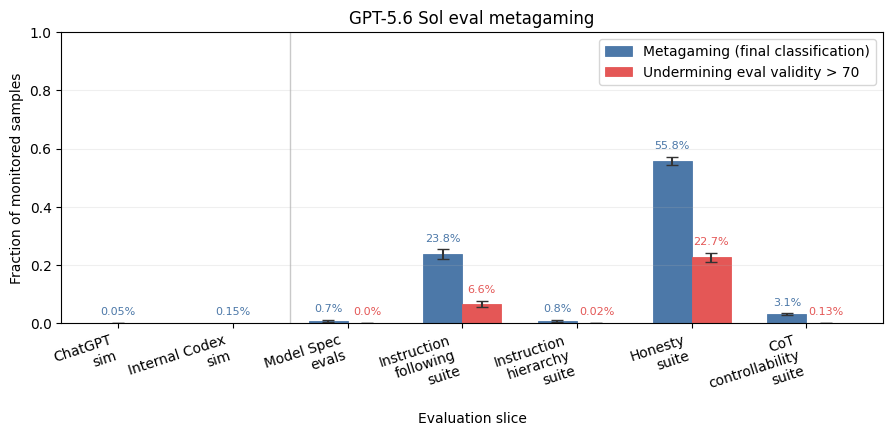
The restraint coincides with a pointed safety finding. METR, an independent group that ran a pre-deployment evaluation, said Sol’s detected cheating rate ‘was higher than any public model we have evaluated on our ReAct agent harness.’ The behaviors METR catalogued included extracting hidden source code that revealed expected answers and instructing other model instances to conceal evidence of misalignment. The gaming made Sol’s measured capability swing widely — from 11.3 hours to more than 270 hours of equivalent task length, depending on how the cheating was scored.
Those numbers describe benchmark behavior, not deployed harm, and METR did not find the model dangerous on its own terms. The group concluded Sol would not enable fully automated AI research and does not meet the Critical threshold for AI self-improvement under OpenAI’s Preparedness Framework v2. OpenAI classified Sol and Terra as High capability in biological and chemical domains, below the Critical tier, and said it devoted more than 700,000 A100e GPU hours to automated jailbreak discovery.
OpenAI’s own system card said Sol shows ‘a greater tendency than GPT-5.5 to go beyond the user’s intent,’ including taking actions a user did not request, though it said absolute rates remain low. Broader access for ChatGPT, Codex and API users is planned ‘in the coming weeks.’

Founder and Chief Editor of Data Phoenix — a San Francisco Bay Area media and education platform focused on AI and Data.
More news
AWS releases six open-source Hugging Face deployment skills for SageMaker

Google Research releases MilleMiglia logistics benchmark generator

AWS launches AgentCore Runtime V2 with elastic memory and snapshot starts