Google DeepMind's Aeneas helps historians restore, date and attribute provenance to Roman inscriptions
Google DeepMind's Aeneas AI model revolutionizes ancient history research by analyzing Roman inscriptions with 73% accuracy in text restoration and helping historians find contextual parallels in seconds rather than weeks.
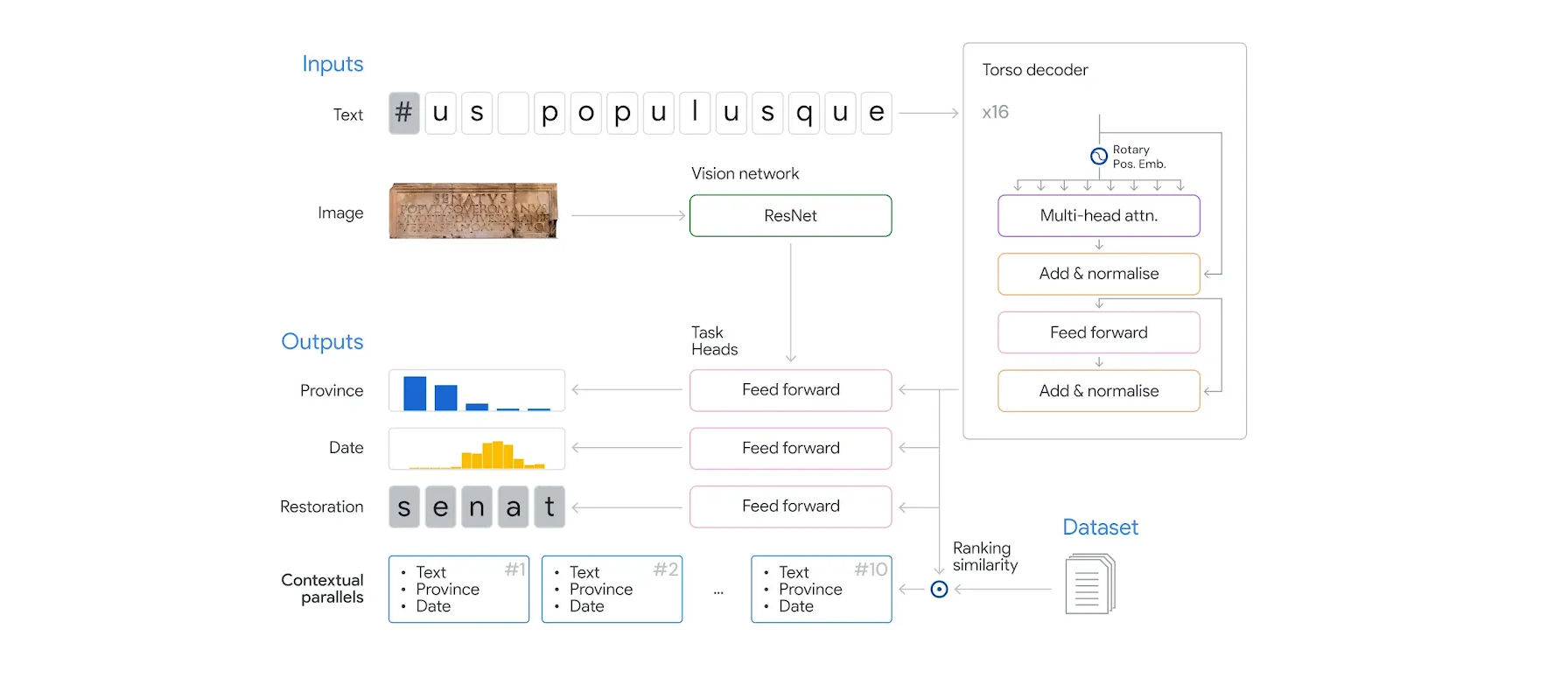
In a recently published paper in Nature, Google DeepMind unveiled Aeneas, a multimodal neural network designed to assist in restoring damaged texts, determining their origins, and finding contextual parallels across thousands of Latin inscriptions in seconds. Because of its capabilities, Aeneas can help accelerate work that traditionally takes historians weeks or months to complete.
Aeneas, aptly named after the wandering hero of the Graeco-Roman tradition, builds on Ithaca, an earlier DeepMind model for Greek inscriptions. but goes significantly further. The system analyzes both text and images of inscriptions, creating "historical fingerprints" that help identify connections across the vast Roman world. With a dataset of over 176,000 Latin inscriptions, Aeneas achieves impressive accuracy: 73% Top-20 accuracy for restoring gaps up to ten characters, 58% Top-20 accuracy for gaps of unknown length, 72% for attributing inscriptions to one of 62 Roman provinces, and dating texts within 13 years of expert estimates.
Aeneas's ability to handle gaps of unknown length is a first in the field. The model also differentiates itself from other approaches by its ability to process multimodal inputs, including visual information from inscription images. Moreover, Aeneas's contextualization capabilities help historians interpret isolated fragments and draw richer conclusions about ancient life.
In collaborative studies with 23 historians, researchers found Aeneas most effective when used alongside human expertise rather than as a replacement. The AI accelerated their work and expanded the range of relevant parallels they could identify, with one historian noting that "Aeneas' parallels completely changed my perception of the inscription."
DeepMind is making Aeneas freely available at predictingthepast.com for researchers, educators, and museum professionals; the code and dataset have also been open-sourced. Additionally, Ithaca has been upgraded with the contextualization function, the capability for restoring gaps of unknown length, and an overall performance boost.
Ellie Ramirez-Camara is the News Editor at Data Phoenix, where she writes the daily AI newsdesk — covering model releases, research, funding rounds, and policy across the AI and machine-learning industry. She tracks announcements from labs and startups alike and distills them into clear, source-linked reporting for practitioners.
More news
AWS releases six open-source Hugging Face deployment skills for SageMaker
Google Research releases MilleMiglia logistics benchmark generator
AWS launches AgentCore Runtime V2 with elastic memory and snapshot starts