ECON: Explicit Clothed humans Obtained from Normals
ECON combines the best aspects of implicit and explicit surfaces to infer high-fidelity 3D humans, even with loose clothing or in challenging poses. ECON is more accurate than the state of the art. Perceptual studies also show that ECON’s perceived realism is better by a large margin.
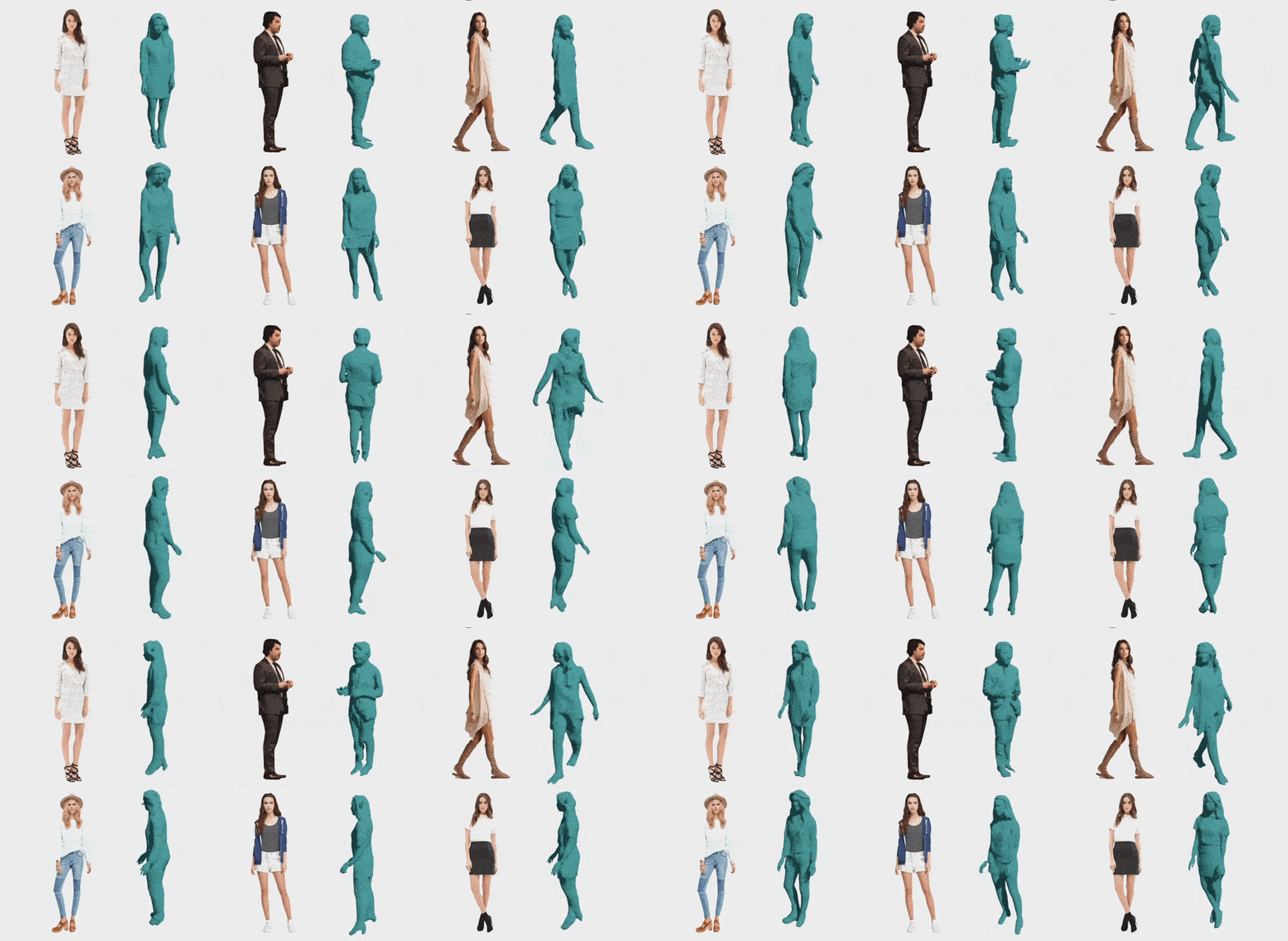
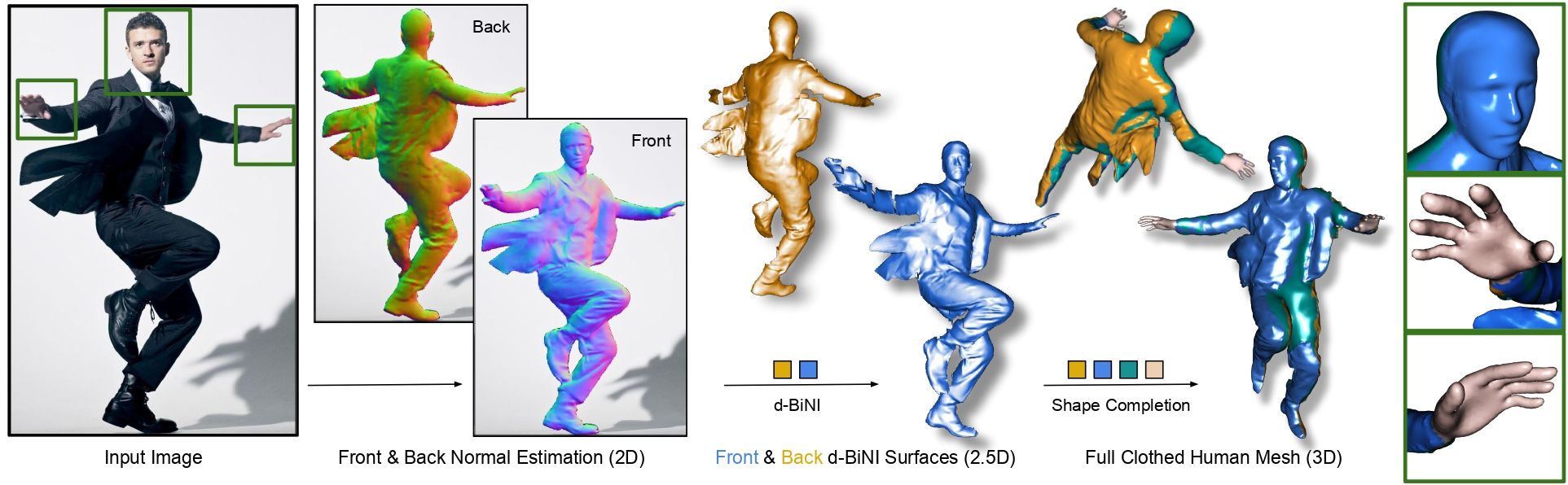
Human digitization from a color image. ECON combines the best aspects of implicit and explicit surfaces to infer high-fidelity 3D humans, even with loose clothing or in challenging poses. It does so in three steps: (1) It infers detailed 2D normal maps for the front and back side. (2) The normal maps are converted into detailed, yet incomplete, 2.5D front and back surfaces guided by a SMPL-X estimate. (3) It then "inpaints" the missing geometry between two surfaces If the face or hands are noisy, they can optionally be replaced with the ones from SMPL-X, which have a cleaner geometry.
Abstract
The combination of artist-curated scans, and deep implicit functions (IF), is enabling the creation of detailed, clothed, 3D humans from images. However, existing methods are far from perfect. IF-based methods recover free-form geometry but produce disembodied limbs or degenerate shapes for unseen poses or clothes. To increase robustness for these cases, existing work uses an explicit parametric body model to constrain surface reconstruction, but this limits the recovery of free-form surfaces such as loose clothing that deviates from the body. What we want is a method that combines the best properties of implicit and explicit methods. To this end, we make two key observations:(1) current networks are better at inferring detailed 2D maps than full-3D surfaces, and (2) a parametric model can be seen as a “canvas” for stitching together detailed surface patches. ECON infers high-fidelity 3D humans even in loose clothes and challenging poses, while having realistic faces and fingers. This goes beyond previous methods. Quantitative, evaluation of the CAPE and Renderpeople datasets shows that ECON is more accurate than the state of the art. Perceptual studies also show that ECON’s perceived realism is better by a large margin.
Video

Founder and Chief Editor of Data Phoenix — a San Francisco Bay Area media and education platform focused on AI and Data.
Continue reading
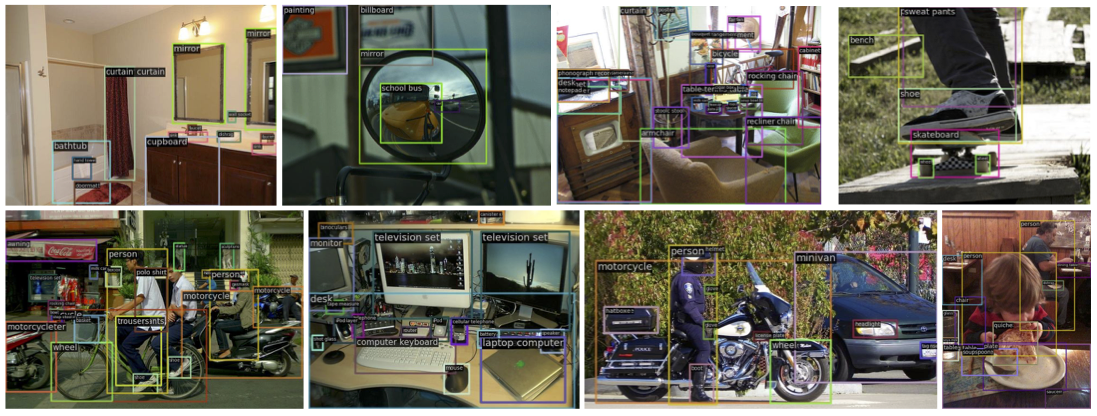
YOLO-World: Real-Time Open-Vocabulary Object Detection
YOLO-World boosts YOLO with open-vocabulary detection via vision-language modeling, pre-training on large datasets. Efficiently detects objects zero-shot, outperforming state-of-the-art in accuracy and speed.
Dmytro Spodarets·Feb 12, 2024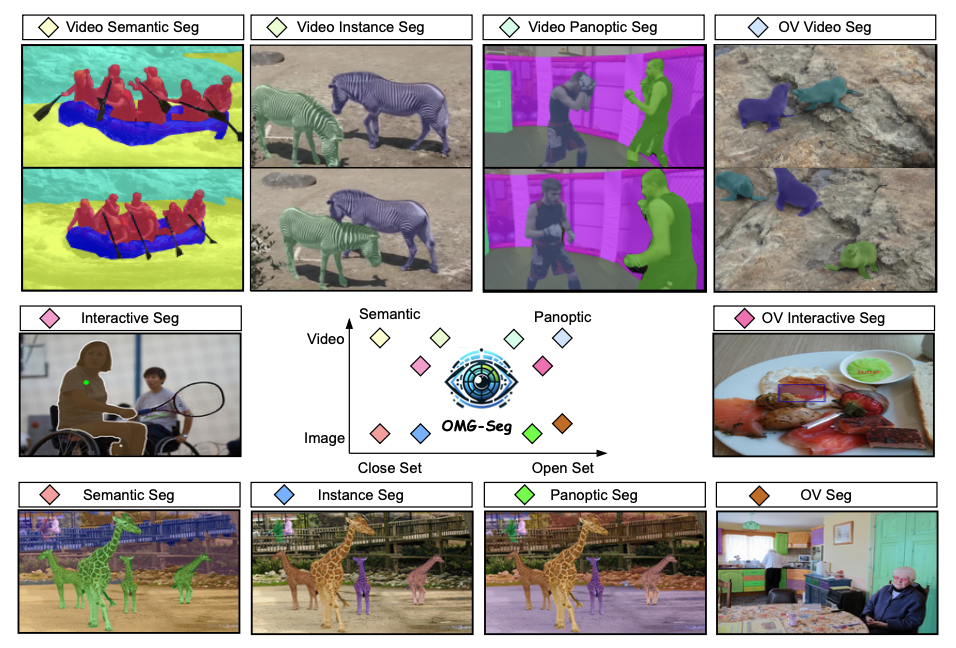
OMG-Seg: Is One Model Good Enough For All Segmentation?
OMG-Seg is One Model that is Good enough to efficiently and effectively handle all the segmentation tasks, including image semantic, instance, and panoptic segmentation, as well as their video counterparts, open vocabulary settings, prompt-driven, interactive segmentation.
Dmytro Spodarets·Feb 8, 2024
InstantID : Zero-shot Identity-Preserving Generation in Seconds
InstantID, powered by diffusion models, offers plug-and-play image personalization in various styles using one facial image, ensuring high fidelity. It demonstrates remarkable efficiency and performance, making it highly beneficial for applications requiring identity preservation.
Dmytro Spodarets·Feb 5, 2024